There are a lot of reviews and discussion on the internet about Prometheus. I don’t want to duplicate those here — rather, my goal with this post is to focus on whether Prometheus should be considered a “Lovecraftian” movie.
After I watched it, one of the theater employees asked me if I liked it. I said yes, and then she told me that the reaction to the movie was about 50/50. Here’s why, in my opinion: It’s all about expectations.
If you go into the theater expecting a prequel to Alien and Aliens, with lots of monsters running around killing people, you’re going to be disappointed. That’s not what the movie is about.
If, however, you are looking for a philosophical movie that asks questions about where we come from and why we are here, you should enjoy Prometheus very much. Throw in some awesome special effects, some very creepy scenes and great action, and it gets even better.
But I’m writing this for a Lovecraftian audience. So the question before us is, “Is Prometheus a Lovecraftian movie?”
In my opinion, yes. Absolutely.
(Some minor spoilers follow the trailer.)
What makes Prometheus Lovecraftian? The fact that it deals with several Lovecraftian themes: Discovering where we come from and why we are here, and being horrified by the answer. Asking ourselves if there is a god, if there is a creator, or not. Another Lovecraftian theme is the horrifying consequences of the pursuit of forbidden knowledge… and Prometheus delivers on that theme in spades.
To some, finding out that there is no god would be mind-shattering. But what about finding out that there is a creator… and he doesn’t like us very much? What if you met “God”, and he told you that you and your fellow humans were basically just a failed experiment… one he’s decided to terminate?
Now that’s horror. And that’s definitely Lovecraftian horror.
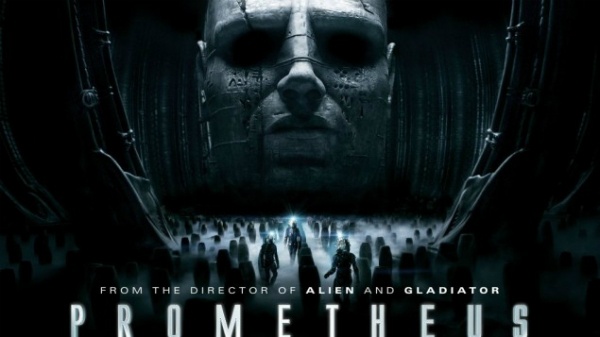
After searching all his life for answers, Peter Weyland finally meets “God”, aka the “Engineers”, and instead of welcoming him, they bludgeon and kill him. With his dying breath he gasps, “There really is nothing.” In other words, not only is there not a caring God up there, waiting to welcome you to Heaven when you die, but he actively despises what he has created: You.
Shades of Lovecraftian gods, especially the ones in At the Mountains of Madness.
When Weyland says “there is nothing”, his creation, David the android, replies: “I know.” He’s already given it a lot of thought. In a previous discussion with Holloway (one of the scientists), David asks him what he hopes to achieve by trying to find the Engineers:
Holloway: What we hoped to achieve, was to meet our makers. To get answers. Why they even made us in the first place.
David: Why do you think your people made me?
Holloway: We made you because we could.
David: Can you imagine how disappointing it would be for you, to hear the same thing from your creator?
Prometheus doesn’t give easy answers; in fact, it gives very few answers at all, much like many of Lovecraft’s stories. But I think the main “lesson” of Prometheus is this: There may be no meaning to life, and that hurts — it hurts deeply. BUT… as David repeats after watching Lawrence from Arabia, maybe the trick is not minding that it hurts. There may be no ingrained meaning to life, but life can still have meaning — the meaning that we give it.
Thoughts? Comment below!

FUN STUFF…
You may be interested to know that Earth has received a terrifying transmission from the Prometheus:
[audio http://www.prometheus-movie.com/uploads/PrometheusCrewTransmission.mp3]Here is a flash remake of “Aliens the Board Game”.
5 Things You Might Not Know About Ridley Scott’s “Alien”
Scientific American: Ridley Scott’s Prometheus Examines the Roots of Alien‘s Mythology
Discover more from The Lovecraft eZine
Subscribe to get the latest posts sent to your email.
 The Lovecraft eZine
I just spent an evening catching up with a school friend who I haven’t seen for 20 years, he now works in universal pictures. He told me that the reason why Guillermo Del Toro wasn’t going to be able to make “At The Mountains of Madness” was because the studio decided that an 18 movie with a $20 million price tag would never recoup its money. Not because Prometheus got there first.
LikeLike
Sounds like Ripley rehashed bits of “Blade Runner,” lol. Not that I mind; I adore “Blade Runner.” It also has themes of creation–the androids were tools and treated as such (killing an android isn’t considered “murder”–only retirement), even though they wanted to be something more. The entire film has a gritty, nihilistic feel. There’s also an android Jesus (Rutger Hauer’s character).
LikeLike
Yeah, I think Guillermo is full of it. We still need a AtMoM movie!!!
LikeLike
It was a choppy movie in places, no doubt about it. It definitely probed many of the same themes as Lovecraft’s work, and I got a thrill from its similarity to “At The Mountains of Madness” — apparently it’s so similar that Guillermo Del Toro feels his movie version would be moot now. (my review, for anyone interested, is here: http://movieink.net/2012/06/06/movie-review-prometheus/)
LikeLike
Chris: [SPOILER ALERT!] I was bothered by the three pilots’ instantly agreeing to sacrifice themselves to stop the alien ship taking off…the movie didn’t build these guys up to be valiant heroes willing to lay down their lives for the good of humanity. It was like “Oh, kill ourselves by doing a Kamikazee run? Sure, no problem dude!” Although I hear 30 to 45 minutes of the film was cut, so maybe we lost a lot of second-string character development. The only characters who are fully realized are Shaw, David, and perhaps Vickars.
That bugged me, but it didn’t stop me from enjoying the sheer spectacle of the thrill-ride.
LikeLike
Hey, Mike! Well, Lovecraft, by all accounts, certainly DID believe in the insignificance of humanity as related to the cosmos. I tend to side more with the ancient Indian philosophy of Vedanta (which echoes throughout many different religions to a different degree), although I’m not a “religious person”. Basically, we ARE the universe, and the universe is US. We are here because we are the Infinite manifesting itself in the Finite–we are the universe looking back at itself, so to speak. We are here to learn, to observe, and to experience. I believe this is the case with ALL life forms–those we know about and those we haven’t yet discovered. But that’s just my philosophy based on the studies I’ve done into spirituality, philosophy, etc. I don’t force my beliefs on anyone, but I do think that we are inseparable from the greater universe–we are all a part of the Unified Field of Existence, as drops of water are part of the ocean. Okay, enough philosophizing–I’m sure Lovecraft wouldn’t agree! 🙂
PS. I do see where you’re coming from in your analysis of the movie. I found it a fun and horrifying thrill-ride.
LikeLike
I agree with your assessment on the Lovecraftian nature of the film Mike. You wisely kept it focused on that, and didn’t get too far into the convoluted over analysis of the film.
LikeLike
when they took off to “find god” it’s obvious they crashed on LV-426 later and the Nostromo picked up the signal,since Ripley and crew did not show up on Zeta 2 Reticuli.
LikeLike
I’m one of the 50% who were disappointed with Prometheus, but not exactly for the reasons stated above. I didn’t hate it. It was really a beautiful and well visualized film. The effects and the worlds and creatures it presented were really spectacular. I didn’t have a problem with all the questions left unanswered, nor with the philosophical bent of the movie. My let down was with the poorly drawn characters who’s questionably motivated actions and reactions play so badly against the amazing and terrible worlds they experience. Scientists who gleefully remove their helmets and opt to play with unknown fauna on alien worlds become nothing more than the stupid teens from a slasher film staged many light years from Earth. The fact that the characters themselves never question the myriad of surprises and unexplained events that appear with alarming regularity made it more and more difficult to suspend my disbelief. I don’t think I agree that Prometheus is really Lovecraftian either. Although the idea of a godless universe is featured in Prometheus, the fact that (according to an interview with RS) the Engineers create “Jesus” and it is humanity’s murder of him 2000 years ago that sparks their desire to destroy mankind. This means that the Engineers have some sort of “good” if unknown agenda, far different from Lovecraft’s uncaring universe. The protagonist Shaw clings to her crucifix throughout the movie and is the only living survivor, still bent on finding her creator, which might imply that their is a God behind the Engineers after all. Her “belief” is key. Prometheus featured lots of tentacles though, so you gotta give it credit for that!
LikeLike
Chris, you wrote: “Although the idea of a godless universe is featured in Prometheus, the fact that (according to an interview with RS) the Engineers create “Jesus” and it is humanity’s murder of him 2000 years ago that sparks their desire to destroy mankind.”
That’s very interesting. I hadn’t heard that — do you have a link? I’d love to read that interview.
LikeLike
Hi Mike! I’ve seen the Ridley Scott “Space Jesus” references a few places now with all the hoopla, but here’s a link to one of them with other backstory as well:
http://blastr.com/2012/06/this-awesome-theory-expla.php
Cheers! Chris
LikeLike
My thoughts as well Chris…..I will be buying the dvd though….
LikeLike
I respectfully disagree. Lovecraft’s hypothesis behind most of his work was that mankind and its petty concerns are utterly insignificant in the face of a vast, uncaring cosmos. The Old Ones, the Elder Gods, all the mythos creatures such as Cthulhu and Yog Sothoth and Azathoth–we are less than gnats to them…literally beneath their notice. I find PROMETHEUS’ conceit that a race of advanced aliens actually CREATED humankind goes against the most fundamental of Lovecraft’s theoretical underpinnings. In Lovecraft’s view of the universe, humankind is simply the equivalent of microbes in a bubble of snot. Also, Lovecraft maintained that IF we achieved some kind of otherwordly insight into the true nature of the universe, our tiny minds simply could not handle it–the only response would be gibbering insanity. While I don’t agree with Lovecraft’s nihilistic vision of reality, I do feel that it creates some amazing horror stories–and I don’t think PROMETHEUS even came close to it. Afterall, the movie’s characters do uncover forbidden knowledge, and nobody is driven mad by it–they’re simply slaughtered by big, tentacular creatures–if anything that is merely a surface similarity to Lovecraft’s creations. “Tentacled monstrosities” do not equal “Lovecraftian.” PROMETHEUS was a fun movie, but there’s nothing in there that will prohibit a MOUNTAINS OF MADNESS movie, despite what Guiermo Del Toro thinks–sounds like he needs to re-read that story after seeing this movie. Two different beasts. (Pun intended.)
LikeLike
John, I agree with your assessment and I think your write up much superior to mine! 🙂
LikeLike
Thanks for the comments, John. I am not saying that the movie perfectly applies Lovecraftian themes, what I’m saying is that the movie (IMHO) is Lovecraftian because it does have some HPL themes. In AtMoM, for example, the “gods” created the shoggoths, if memory serves. They could have just as easily have created humans. Finding out that you don’t matter in the universe is certainly Lovecraftian.
Consider, too: What if we as humans found out tomorrow that an alien race designed us, and that they hate us and will destroy us when they can? I don’t think it’s much of a stretch to imagine that knowledge driving quite a few people crazy. It’s easy to take it for granted in a story, but if we found out that this was a fact, at the very least we would be horrified. Many people would possibly go mad; certainly many people would feel hopeless and devoid of meaning.
Just to make it clear: Any tentacles in the film didn’t enter into my thinking at all. What makes “Prometheus” Lovecraftian (to me) is that it to a degree does employ cosmic horror, meaninglessness, nihilism, hopelessness.
One of the lessons of Lovecraft’s stories is that humans don’t matter. The universe doesn’t care one bit about us. Could “Prometheus” have done that better? Sure. But the message still gets across.
You said you don’t believe that Lovecraft’s nihilistic vision of reality is actually real. I do, and I don’t. I don’t believe powerful alien gods might return to Earth one day to stomp on us; but on the other hand, humans are NOT important in the universe. If Earth blew up tomorrow, the universe wouldn’t care. To that extent, I feel the “reality” in HPL’s fiction.
Anyway, I really do appreciate your thoughts, and thanks for reading.
LikeLike
Re At the Mountains of Madness – I thought the implication in the story was that the Elder Things created all life on Earth, including humans, and hence genuinely were our progenitors. There are clear similarities to Prometheus in my personal opinion (I assume that the alien seen in the opening scene was doing just that – inadvertantly creating life on Earth) and I enjoyed the parallels the article drew.
LikeLike
I couldn’t help get chills when the ship was descending and when they passed the first mountain Ford say something along the lines of “makes everest looks like a baby brother” and when they showed the flute……that terrible pipping noise…
LikeLike
And yet Noomi Rapace’s character, Shaw, refuses to give up, even after that answer: “But who made them?” Then she and David go off in search of “god’s” homeworld. Talk about never learning your lesson. Or has she lost all her SAN points already? I felt like you could watch the android losing his as the movie went on, and he had little to begin with.
LikeLike