Several authors, film-makers, and publishers advertise with me; you’ll find links to their books and movies on the right sidebar of this website. As always, though, I want to reiterate that I do not advertise books that I don’t feel are a good read. In other words, if someone wanted to advertise a book I didn’t like, I’d have to say no.
With that in mind, here are the current books advertised on my sidebar; if you’re looking for something new to read, please consider purchasing one or more of these books. The ad money helps to keep Lovecraft eZine alive.
Click the titles to purchase the books or movies!

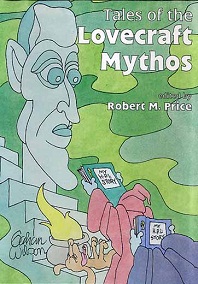 When H.P. Lovecraft first introduced his macabre universe in the pages of Weird Tales magazine, the response was electrifying. Gifted writers—among them his closest peers—added sinister new elements to the fear-drenched landscape. Here are some of the most famous original stories from the pulp era that played a pivotal role in reflecting the master’s dark vision.
FANE OF THE BLACK PHARAOH by Robert Bloch: A man obsessed with unearthing dark secrets succumbs to the lure of the forbidden.
BELLS OF HORROR by Henry Kuttner: Infernal chimes ring the promise of dementia and mutilation.
THE FIRE OF ASSURBANIPAL by Robert E. Howard: In the burning Afghan desert, a young American unleashes an ancient curse.
THE ABYSS by Robert A. W. Lowndes: A hypnotized man finds himself in an alternate universe, trapped on a high wire between life and death.
AND SIXTEEN MORE TALES OF ICY TERROR!
 Worlds of Cthulhu is a collection of new stories in a Lovecraftian vein. Editor R.M. Price has selected these sequels, “prequels” and interstitial tales, some of which are “Mythos” tales, and some not.
Price introduces the book as a whole, as well as each story.
Stories include “There Are Kings” by Richard Lupoff; “Envy, the Gardens of Ynath, and the Sin of Cain” by Darrell Schweitzer; “The Arcade,” by Will Murray; “The Chaos Blade,” by Adrian Cole; “Evacuation Day,” by Will Murray; “The Statement of Frank Elwood,” by Pete Rawlik; “The Testament of Alexander Fletcher,” by K.M. Tonso; “The Serpents of Tenoka,” by Ron Shiflet; “The Journal of Thomas Gedney,” by Pete Rawlik; “The Tower of Mormoroth,” by Gary Myers; and “The Signal Tower,” by Rafe McGregor.
Dust jacket illustration by Gahan Wilson; endpaper illustrations by Tim Kirk.
 Never has a Lovecraft film captured so much of the master’s atmosphere on screen. –Craig Mullins, Unfilmable.com
It is rare that I am haunted by a film as I was by Pickman’s Muse. The film is an exceptionally effective production of Lovecraftian horror! –Wilum H. Pugmire, author of Sesqua Valley & other Haunts
An outstanding performance by Barret Walz. –Horror Yearbook
Robert Pickman has become obsessed by visions of unworldly horror, revealed to him through an ancient artifact discovered in an abandoned church. His doctor and friend, Ambrose Dexter, is soon drawn into the mysteries surrounding Pickman’s newfound obsession, and struggles to combat forces determined to drag Pickman down the inevitable road to madness.
Inspired by: H.P. Lovecraft’s, HAUNTER OF THE DARK
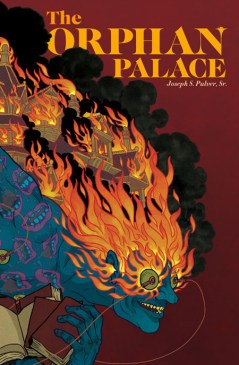 Available for Kindle and in print. Awesome book. But don’t take my word for it, check out the reviews at Amazon: http://amzn.to/10kQFEx
Cardigan is heading east through the night-bleak cities of America and back to confront the past he has never escaped, as a resident of Zimms, an orphanage-cum-asylum and a true palace of dementia, presided over by the ‘Chaos Lord’, Dr. Archer. His odyssey is one of haunting flashbacks and disorientating encounters on the road as he leaves a trail of fire and destruction behind him. In the circles and dead-ends that make the maze of his madness, Cardigan meets bounty hunters, ghosts, ghouls, a talking rat, even a merman, and struggles to decide which will lead him to damnation and which to salvation.
With The Orphan Palace, Joseph S. Pulver takes the ‘weird fiction’ mythologies of Robert Chambers, Frank Belknap Long and H.P. Lovecraft, melts them in the crucible of his own unique noir poetry and cooks up a hallucinatory road-trip that is utterly unexpected.
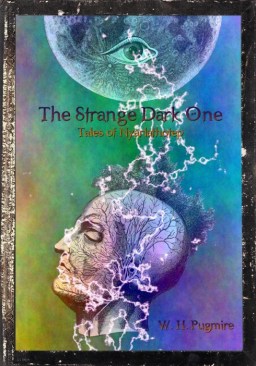 With The Strange Dark One, W. H. Pugmire collects all of his best weird fiction concerning H. P. Lovecraft’s dark god, Nyarlathotep.
This avatar of the Great Old Ones is Lovecraft’s most enigmatic creation, a being of many masks and multitudinous personae. Often called The Crawling Chaos, Nyarlathotep heralds the end of mortal time, and serves as avatar of Azathoth, the Idiot Chaos who will blow earth’s dust away. Many writers have been enchanted by this dark being, in particular Robert Bloch, the man who, through correspondence, inspired Wilum Pugmire to try his hand at Lovecraftian fiction.
This new book is a testimonial of Nyarlathotep’s hold on Pugmire’s withered brain, and these tales serve as aspects of a haunted mind. Along with stories that have not been reprinted since their initial magazine appearances, The Strange Dark One includes “To See Beyond,” a sequel-of-sorts to Robert Bloch’s groovy tale, “The Cheaters;” and the book’s title story is a 14,000 word novelette set in Pugmire’s Sesqua Valley.
The Strange Dark One is a collection of Lovecraftian fiction by W. H. Pugmire. Each tale is beautifully illustrated by the remarkable Jeffrey Thomas, who is himself one of today’s finest horror authors.
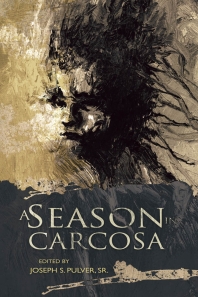 The King in Yellow, a series of vaguely connected short stories having as a background a monstrous and suppressed book whose perusal brings fright, madness, and spectral tragedy, really achieves notable heights of cosmic fear… — H.P. Lovecraft
All new KING IN YELLOW tales! Laird Barron, Cody Goodfellow, and more. Edited by Joseph S. Pulver, Sr.
Discover more from The Lovecraft eZine
Subscribe to get the latest posts sent to your email.
 The Lovecraft eZine
I always thought Heart of Darkness was an unsung proto-Lovecraftian work. The way the jungle is portrayed as an actively malevolent force that drives Kurtz to madness and “unspeakable rites.” And not to mention the abundance of purple prose that somehow just works.
“The wilderness had patted him on the head, and, behold, it was like a ball – an ivory ball; it had caressed him, and – lo! – he had withered; it had taken him, loved him, embraced him, got into his veins, consumed his flesh, and sealed his soul to its own by the inconceivable ceremonies of some devilish initiation. “
LikeLike