(This review is by Cody Lakin, author of The Family Condition and The Aching Plane.)
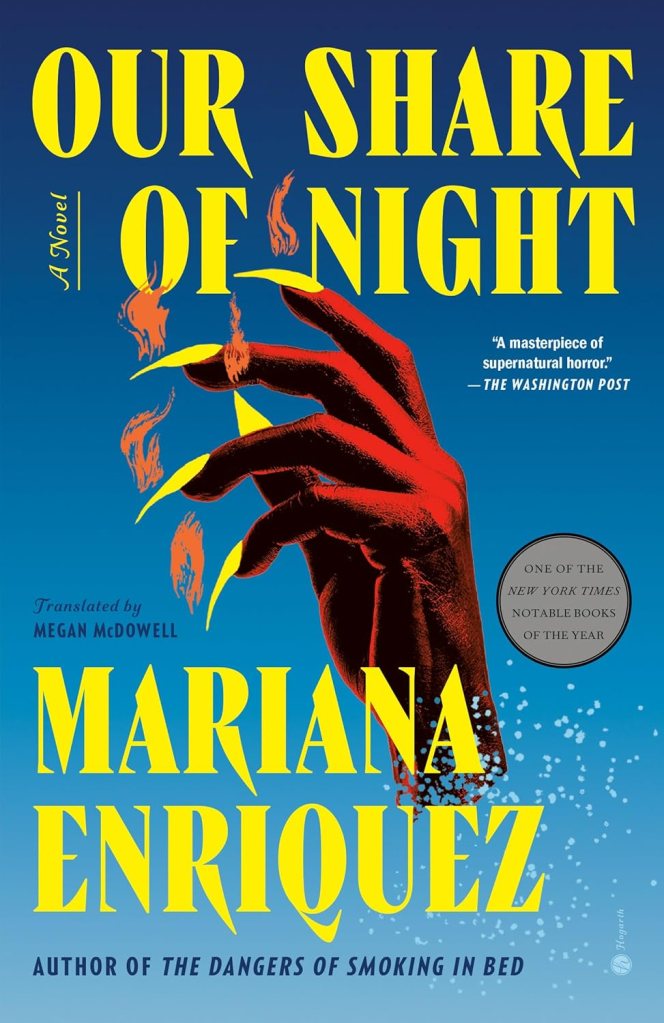
Our Share of Night, by Mariana Enriquez:
It begins with a father and son. We know only a few things about them. The father is formidable in stature and aura, but he is also frail and battered. Something is wrong with him inside, something about his heart. The son, hardly more than a small child, is both wise and scared. He sees things he doesn’t know how to make sense of. Between father and son there is more love and darkness than we, at the onset, can imagine. And as time catapults forward alongside the narrative, we learn just how terrible the son’s inheritance is, for he was born from two people who loved each other, but whose lives exist in the jaws of an unimaginable horror.
Only a handful of times in my life have I had the privilege of an experience like the one Mariana Enriquez’s OUR SHARE OF NIGHT gave me. I shut the book after the final page, closed my eyes, and thought: This is one of the best books I have ever read, and probably one of the best I will ever read. It lives in my heart the way a heavy secret lives, bursting at the seams to be understood.
I approach what I read from two perspectives: as a reader and lover of literature, of course; and also as a writer—a student of the craft. My favorite writers are equally my teachers. OUR SHARE OF NIGHT didn’t leave me merely with the feeling of having experienced a rare and incredible piece of literature; it made me feel as though I’d truly lived through something, and it left me in awe that a person had crafted such an immense experience. To call it inspiring feels like a disservice. This book is on a level all its own. I feel inadequate just trying to write about it.
The story moves through many historical and cultural layers. Argentina’s brutal dictatorship and “dirty war” and the aftermath—the emptiness afterward—form the backdrop of the novel: the violence, the disappearances, the grief, the unanswered losses that echo through generations. In the early pages, the main character recalls the days of the dictatorship, his psychic sensitivity alert to the terrible realities all around. He remembers that the city was screaming. An air of irreconcilable loss and sorrow haunt the main characters of the novel, not merely due to the world they live in, but because of what they do to themselves and to each other, often in the name of love.
What forms the heart of the story is the complex familial relationships at the center. In some frightening and often uncomfortable ways, this book is about the dark burden of inheritance, and what a parent carries on their shoulders in order to try and protect their children. The burden of sacrifice; the inevitable pain that will be caused by both parent and child; the light as well as the darkness that is passed on and inherited.
As much as this is a deep and inimitable horror novel, it is also a multilayered literary work. I was surprised by a turn in the story diving into trauma and depression, how the story approached it with such familiar sensitivity and palpable realism. I suffer depressive episodes, and so, in the midst of such an immense book and its many layers, these sections caught me off guard. There is light in this book: the wonderful sides of companionship, memory, and hope, for example. The solace of friendship and chosen family. But there is a pervasive darkness that runs like sickness through the body of this novel. As much of the horror is found in the mysterious, supernatural, and cosmic, as it is in the depravity of what people will do to other people—even family. What surprised me about the book’s exploration into depression and trauma, then, was in how sharply real it felt to see what all these things will do to a person’s psyche, tainting their ability to live anything like a normal life. This happens to be one of my favorite things in the horror genre: when a story explores real-life horrors alongside the supernatural or otherworldly; and when a story explores the aftermath.
In this way, OUR SHARE OF NIGHT explores not only these different types of horrors—both the unreal and the all-too-real—but it also dives into what it means to live with the horror, to carry on with unnamable and unmanageable darkness inside. And it does this with an sharp sense of authenticity and emotional truth.
It’s epic in its scale and context, yet so intimate in its telling. Enriquez’s writing places you right there with the characters, immersed. Even what it leaves unspoken feels resonant and powerful: the passage of time and intention; the good and the bad and the bittersweet of legacy, of what we remember or what we forget. She writes with the same casual, vivid clarity about a father and son’s visit to a waterfall, as she does about suffering, torture, death, or the violent hunger of a cosmic entity as it consumes a person’s body. Or, just as deftly, the story reveals how thoroughly it has found its way under your skin and into your heart. More than a few passages left me disarmed, in tears, deeply touched and aching for the characters—their grief, their hope, their healing. Other passages made me want to turn away in disbelief, shock, and horror.
OUR SHARE OF NIGHT feels like an experience I lived through and emerged altered. It’s an aching story, as beautiful as it is tragic and rampant with all kinds of haunted and tormented darkness. It is among the most profound reading experiences I’ve ever had, run through with a never-wavering sense of authenticity and emotional truth that brought it fully to life, page by page.
This book is a staggering, monstrous spectacle. Even though some time has passed since I first turned the final page, I feel steeped in it, in what it did to me, indicated by the dreams it inspired and by how equally inspired and intimated I am by it. When I remember my time with it, I can see the impossible, hungry darkness as it searches for sustenance, surrounded by its worshippers screaming and moaning and laughing. I am afraid of its hunger, of what it can do to the body but, just as much, what it can do to the mind. But I remember, too, the father and son together, at the waterfall. The legacy of love and what it can do against any amount of darkness.
This review is by Cody Lakin, author of The Family Condition and The Aching Plane.

Join The Lovecraft eZine Patreon! For only $5 a month you get an insane amount of content: interviews with Laird Barron, Ramsey Campbell, Nadia Bulkin, John Langan, and many others. AND you’ll be helping to keep the eZine going. I need all the help that I can get.
Discover more from The Lovecraft eZine
Subscribe to get the latest posts sent to your email.

